Welcome to our fracture studies website. This site details our decades of work with natural fractures and their implications to fluid flow. Enjoy!
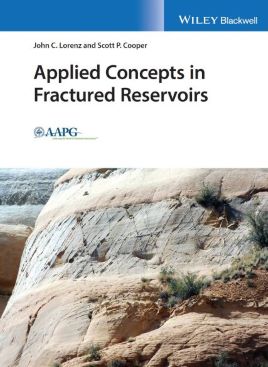
BOOKS, WEBINARS, ARTICLES, SHORT COURSES AND FIELD TRIPSAPPLIED CONCEPTS IN FRACTURED RESERVOIRS Available through Wiley Blackwell and AAPG. The 2020 book covers the understanding, evaluation, and effects of fractures on reservoirs. It offers a comprehensive, practical discussion and description of natural fractures, their origins, characteristics, and effects on reservoir permeability. It introduces the reader to basic definitions and classifications of fractures, then provides a guide for fractured-reservoir characterization and analysis. It also includes discussions of the way fractures impact oilfield operational activities. Well organized and clearly illustrated, Applied Concepts in Fractured Reservoirs starts with a section on understanding natural fractures, addressing different fracture types, their dimensions, and the mechanics of fracturing rock in extension and shear. The next section provides information on measuring and analyzing fractures in reservoirs. It covers logging core for fractures, assessing fractures in new core vs. old core, image logs, and more. The last part of the volume examines the effects of natural fractures on reservoirs including fracture volumetrics, the effects of fractures on drilling and coring, the interaction between natural and hydraulic fractures, and the permeability behavior of both individual fractures and fracture systems. This book compiles various concepts and descriptions that have been scattered in the literature, and synthesizes them with unpublished oil-field data and the authors' experience. The book is a valuable reference for geologists and engineers who need to understand naturally fractured reservoirs in order to efficiently extract hydrocarbons, and helps bridge the gap between these disciplines. It is illustrated in full color throughout, and is a companion volume to the authors' Atlas of Natural and Induced Fractures in Core (see below). The online review by Dr. Tim Needham for The Geological Society (of London) in part states "The book distils useful information for the geologist but also shows where geophysical and engineering disciplines are linked, as successful fractured reservoir analysis requires. The strength of the book is that it provides practical advice for anyone seeking to study fractured core. It is very clearly illustrated throughout with plenty of examples of different fracture types, both in the field and the core store...As someone who has spent many years describing fracture systems in core I can thoroughly recommend this book as an excellent primer, regardless of the type of study being undertaken, be it commercial or driven by scientific curiosity." The full review can be found here.
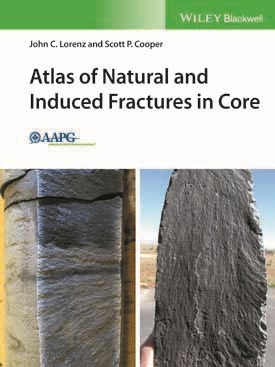
ATLAS OF NATURAL AND INDUCED FRACTURES IN CORE Available through Wiley Blackwell and AAPG. The 2018 Atlas contains over 550 color photographs and figures, with complete detailed descriptions that illustrate the multitude of natural and induced fractures in core. The atlas is divided into three main sections: 1) Natural Fractures, 2) Induced Fractures, and 3) Artifacts. The natural fractures section highlights extension and shear fractures and various other natural fracture types plus the mineralization (real and false) or dissolution that may alter the permeability of these fractures. The induced fractures section details the wide-variety of fractures that can be formed during the drilling and handling processes. This section includes the all-important discussion on how to differentiate natural from induced fractures in core and what induced fractures can be useful for – like determining the orientation of the in situ principal stresses. The last section describes the fascinating artifacts you may come across during a lifetime of logging core. The online review by Dr. Rob Bowell for The Geological Society (of London) states "this is a high quality publication that should be an essential text in any and all core facilities and essential reading for anyone who spends time looking at core." The full review can be found here. Also - Check out Susan Nash's AAPG Learn!Blog webpage for a great interview titled "All About Fractures: Interview with John Lorenz and Scott Cooper" concerning the Atlas and fractures both natural and induced.
ARTICLES AND REPORTS Recent (2021) authored and coauthored publications these include discussions of how to provide field-based courses in the time of Covid, and analyses of natural fractures, structure and mechanical stratigraphy within the Raton and San Juan basins. Lorenz, J.C., and Cooper, S.P., 2021, Natural fractures and their relationship to structure, stress, and permeability in the Raton Basin; The Mountain Geologist, Rocky Mountain Association of Geologists, v. 58, n. 4, p. 375-410. DOI: 10.31582/rmag.mg.58.4.375 Hart, B.S., and Cooper, S.P., 2021, Mechanical stratigraphy in Mesozoic rocks of the San Juan Basin: Integration of stratigraphic and structural terms and concepts; The Mountain Geologist, Rocky Mountain Association of Geologists, v. 58, n. 2, p. 159-204. DOI: 10.31582/rmag.mg.58.2.159 Rotzien, J., Sincavage, R., Pellowski, C., Gavillot, Y., Filkorn, H., Cooper, S., Shannon, J., Yildiz, U., Sawyer, F., Uzunlar, N., 2021, Field Based Geoscience Education during the COVID-19 Pandemic: Planning, Execution, Outcomes, and Forecasts. GSA Today, v. 31, p. 4-10. DOI: 10.1130/GSATG483A.1 We are developing a series of short natural-fracture articles and reports for LinkedIn and similiar venues. When completed, these papers will be available here for downloading and reference. 1) Fracture Analysis of Wolfcamp Core, Red Hills Unit No. 1 Well, Lea County, NM download. FractureStudies LLC has logged the natural fractures in a publicly-available Wolfcamp core (the Red Hills Unit No. 1 well) cut from the northern Delaware Basin, and assessed the natural-fracture and in situ stress system in the reservoir at this location. The report resulting from this study documents a well-developed and pervasive fracture-permeability system, and illustrates some of the fracture-assessment techniques that can be used to evaluate fracture permeability systems. The cored fracture population consists of 50 natural fractures of three types, dominated by 42 narrow, strata-bound, closely-spaced and incompletely-mineralized vertical extension fractures that are closely-associated with limestone beds. Extension fractures strike ENE-WSW, NNE-SSW, and NW-SE, forming an interconnected fracture network. A single but relatively wide shear fracture records the presence of a second fracture system which provides important conduits to connect the fractured limestones across bedding. The third fracture type consists of small, occluded, ptygmatically-folded extension fracture, which do not contribute to reservoir quality. A promising drill-stem test and significant lost circulation show that the natural-fracture network creates significant system permeability in the reservoir. 2) Dynamically Compatible Fractures in Sandstone Outcrops download. This paper describes an outcrop of the Chinle Formation in north-central New Mexico that exposes two lithologically dissimilar sandstones. These sandstones are cut by significantly different but dynamically-compatible fracture types. This article describes dynamically compatible fractures and their implications to reservoir permeability systems. 3) An Outcrop Example of Variable Fracture Mode in a Sandstone download. The fracture-failure mode of a given lithology is not a constant. This is illustrated by fractures in outcrops of coarse Permian arkoses in central New Mexico where a set of older, dip-slip conjugate shear fractures strikes 70° to an unrelated set of younger vertical extension fractures. The significant change in fracture mode was controlled by either changes in the external stress environment or by modifications of the mechanical properties of the rock during cementation and diagenesis. Predictions of subsurface fractures must consider the potential for varying mechanical properties in the rock.
WEBINAR: USING CT SCANS TO ASSESS FRACTURES IN CORE: PROS, CONS, AND PITFALLS This webinar presentation is on how to use CT (Computed Tomography) scans in the analysis of natural fractures in core was given by John Lorenz at the invitation of Dr. Susan Nash, Director of Innovation & Emerging Science and Technology (at the American Association of Petroleum Geologists) in an online meeting on Innovative Digital Imaging. The talk included considerations of the advantages and disadvantages of CT scans, as well as some of the traps and pitfalls that a fracture analyst should be aware of when using CT scans. The publicly-available talk can be found between the time interval 0:47:30 and 1:06 at https://youtu.be/wnaAwAD3BGk.
WEBINAR: THE IMPORTANCE OF NATURAL-FRACTURE TYPE IN CONTROLLING RESERVOIR PERMEABILITY We produced a webinars for Subsurface Consultants & Associates (SCA) and Explorock SAC of Lima, Peru: a recording of the Explorock presentation is publically available, click here. The webinar explores the importance of differentiating between extension and shear fractures due to the significantly different effects of the two fracture types on reservoir permeability and productivity. The two types create dissimilar drainage anisotropies and fracture-interconnectivity systems. Fractures of the two systems also have distinctly different orientations relative to the in situ stress axes, governing the potential for reservoir stimulation. Finally, fracture type governs the degree of stress sensitivity of fracture apertures to reservoir pressure drawdown during production. Extension and shear fracture systems therefore require different stimulation and production philosophies. In order to recognize shear vs. extension fracture systems it is necessary to understand, fully characterize, and not just count fractures in core. Characterizing fractures is not wasteful "science", it is the work required to understand a reservoir and to efficiently produce the hydrocarbons it contains and to optimize recovery and profitability.
FractureStudies LLC provides insight and solutions for:
WHY DO A FRACTURE ANALYSIS? 1. The advantages and importance of knowledgeable fracture analysis: 2. Why this fracture-analysis team is unique: 3. Multidisciplinary interactions:
TEN (+) REASONS TO TAKE CORE AND DO ALL THAT GEOLOGY STUFF
LIST OF PUBLICATIONS:A partial list of our publications is attached here as a PDF. Two papers published in the American Association of Petroleum Geologists Bulletin (one on fractures within the Spraberry Formation the second on a fracture model based on Teapot Dome) are provided here with permission from AAPG as locked PDFs. Additional publications are available through the AAPG at www.aapg.org. We provide several of our public-domain reports including nine Multiwell Experiment Project Reports as PDFs in our Fracture Studies/Clients page. We can provide additional articles, papers and reports on request. Free public access to our Department of Energy reports through: Information Bridge, Department of Energy Scientific and Technical Information www.osti.gov/bridge/
RECENT AND ONGOING FRACTURED RESERVOIR ANALYSESPublic and Private Investor Reports - previously published public papers/reports provided through links on the Case Studies/clients webpage. Private reports are available as appropriate through direct contact. Kurdistan, Iraq – An AAPG presentation on "Fractured Reservoirs of the Shaikan Anticline, Northern Iraq" is a summary of field and core work and is available as a pdf within our FractureStudies LLC database Shaikan Anticline. This is a singular example of some of our work done over multiple years in the Kurdistan region. Additional descriptions and photographs can be found on our FutureStudies/Contact page. Niobrara Formation: Fracture Types and Distributions – A private-investor report in the development phase – interested and current research participants please coordinate with Dr. Lorenz on project specifics (photos). Tensleep Formation Fracture Study Compendium – A summary of three and a half years of field, outcrop and core studies on the Tensleep Formation for the Enhanced Oil Recovery Institute at the University of Wyoming. The report is available by request at: eoriwyoming.org or as a pdf within our FractureStudies database Tensleep Formation Fracture Study Compendium. Aerial photography: geology of production and analog areas –
STRATEGIC PARTNERSDr. Ahmed Ouenes/FracGeo LLC Enhanced Oil Recovery Institute, University of Wyoming Geologica Black Hills Natural Sciences Field Station, South Dakota School of Mines Subsurface Consultants & Associates SCAL, Inc., Midland, TX
Professional affiliations American Association of Petroleum Geologists (AAPG) Rocky Mountain Association of Geologists (RMAG) CONTACTS
|
"Applied Concepts in Fractured Reservoirs" is a much needed precise and practical treatment of a key topic in the energy industry and beyond....In my view this will become a standard reference for geoscientists and engineers working on fractured reservoirs....the book is well organized and clearly illustrated in an easy to grasp collection of applications for fracture studies." Mohammed S. Ameen (Ph.D., DIC, FGS) Principal Professional in Geomechanics, Saudi Aramco (excerpt from the foreword).
"Lorenz and Cooper have seen it all and understand how to interpret it… I believe that this volume is the ultimate resource for "reading the story and history" of fractures in rocks from core. It is a "must have" volume for all who have, or wish to have, an intimate knowledge of the rocks they work with…" Ronald A. Nelson (Ph.D.) President, Broken N Consulting, Inc. (excerpt from the foreword).
|
 Let us provide you the courses, field trips, (all guaranteed to include lunch stops at fall aspen groves) data and/or interpretations to help analyze and produce your teams’ reservoir.